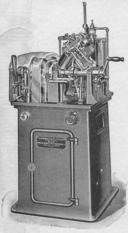
The machines here are all intended primarily to cast individual printing types intended for hand composition.
The Monotype Composition Caster also cast type, of course, but it was intended for casting composed type. For it, see ../ Composing Typecasters -> Monotype Composition Caster.
Noncomposing typecasting machines, covered here, also have a strong relationship with ../ Making Printing Matrices.
NOTE: Most of this isn't done. The parts which do have some possibly useful content are:
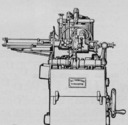
Noncomposing Type Casting Machines
Pivotals, Thompsons, Barths, Küstermanns, Nuernberger-Rettigs, various Monotype machines and many others. There' all together here because trying to divide them into categories (e.g., "sorts" vs. "foundry") was the wrong approach.

Noncomposing Type Finishing/Dressing Machines
[NOT DONE] Before the development of integrated type casting and finishing/dressing machines, there were several machines designed only to finish previously cast type. None of these seem to have been common in the US, but they are shown in several European sources.
Type Founders' Tools
The hand tools of the hand and machine typecaster, including type measurement & alignment tools, pot tools, and general machine maintenance tools. It excludes only those tools specifically associated with particular casting machines (for which see the machine in question) and the few tools specific to casting using the hand mold (such as the ladle).
This is CircuitousRoot Open Source Hardware Series TF.
Ancillary Equipment
External water cooling systems. Metal feeders. Remelt furnaces and equipment. Typemetal assay equipment. Hand tools and supplies. NOTE: Many of these sections are merely pointers to other areas of CircuitousRoot.
See also Typecasting Tools (above and tool lists for individual machines (e.g., A Thompson Type Caster Toolkit).
Literature
General literature about machine typecasting.
Matrix data (including a reprint of Duensing's Matlas, alignment data (especially that from Skyline Type Foundry), and mold height data.
Type Foundry Products
Typefoundries cast type, obviously, but what are the actual products which go out the door?
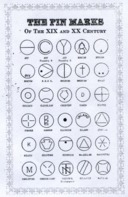
Identifying Metal Type
Notes and sources of information for the identification of metal printing type from its physical characteristics. Pin marks, nicks, grooves, etc.
See also the Notebook on Dimensions and Features of Type in the Making Printing Matrices and Types set of Notebooks.
Type Casting Flaws
A gallery of cast metal types which are less than perfect.
Type Casting Specimens & Type Foundries
(This has become simply a big long list of all Type Foundries and non-composing type caster matrix manufacturers.)
The history of American typefounding is overwhelmingly a history of machine typefounding. Very little survives from the period before the Bruce Pivotal Typecaster. It seems best, therefore, to gather the Notebooks on foundry type design, typefoundry specimen books, and typographical publications by typefoundries here with the noncomposing typecasting machinery they use(d).
See also Composing Linecasters (for Linotype, Intertype, etc.) and Noncomposing Linecasters (for Ludlow, etc.). As usual, the Monotype breaks my categories; most Monotype typographical (matrix) information is in ../ Composing Typecasters -> Monotype, but when the matrix/typographical information concerns specifically matrices made only for noncomposing typecasting, they will be in the present Notebook.
See also the list of Type Foundry House Organs in the ../ General Literature -> Periodicals Notebooks
Fine Press and Amateur Typecasting
Private Presses and commercial Fine Presses which cast at least some of their own type. (Typically for hand composition, sometimes Monotype machine composition; I'll also include linecasting here.) For the typically larger commercial organizations (presses or otherwise) which cast their own type for internal use, see In-House Typecasting, below.
Also amateur or hobby typefoundries which cast for the pure joy of making type without any consideration for printing with it. See also the American Typecasting Fellowship.
In-House Typecasting
This is an impossible topic. In this section I scrape together some of the scattered information identifying those commercial entities (both presses and other) who cast type (for hand setting or as Monotype composition) for in-house use (but were not really "Fine Presses," "Private Presses," or amateur typefounders).
List of All Specimen and Matrix Information Locations on CircuitousRoot
Because my orientation is toward the machinery for making type, and because that machinery is quite varied, specimens of types are scattered all over this website. Here's an index pointing to them.
The 20th Century "Antique" Revival
An index of matters (as discussed here on CircuitousRoot and elsewhere) relevant to the revival of "antique" (so called) and ornamental typefaces in the 20th century.
Our Noncomposing Typecasters
[NOT ONLINE YET] The Thompson and Monotype display typecasters at CircuitousRoot.
Other Typecasters as Parts Of Composing Machines
[NOT DONE; But perhaps just link to their treatment as composing machines?] Sears Typo-matrix (IP 31.3). Goodson Graphotype (IP 31.6). Electrotypograph (IP 31.6).
DeVinne's The Practice of Typography (1900) (from which the separating image of a type mold is taken) is in the public domain.
All portions of this document not noted otherwise are Copyright © 2008-2012, 2022 by David M. MacMillan.
Circuitous Root is a Registered Trademark of David M. MacMillan.
This work is licensed under the Creative Commons "Attribution - ShareAlike" license, version 4.0 International. See http://creativecommons.org/licenses/by-sa/4.0/ for its terms.
Presented originally by Circuitous Root®