See also the List of All Type Specimen and Matrix Information on CircuitousRoot for non-Lanston-Monotype material.
[Note: This Notebook (and the scanning of this Lanston Monotype specimen book) is obviously unfinished. It's a big book and I'm taking it slowly.]
Lanston Monotype typeface and matrix development covered over half a century. There isn't any such thing as "the" Lanston Monotype Specimen Book. Typeface and matrix information (and typographical advertising and advice) tended to be published in the form of small units (from single sheets to small stapled booklets) which, taken at any one time, could constitute a complete specimen book. What I'll try to do here is to reprint all of those small units which are available to me as if they constituted a single specimen book. The material here will be in what seems to me to be a logical order (not necessarily the order in which it appeared in any specimen book).
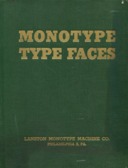
That having been said, as I start this rather long-term project I have only one specimen book available to me. It is a green binder which itself must date after 1943 (the introduction of numeric postal zones) but which contains an index dated 1935. It is entitled on its cover "Monotype Type Faces." I'll indicate this volume with the code "{MTF1}".
Monotype Type Faces (cover only)
For those of you whose lives would not be complete without a 64 Megabyte scan of a green binder cover.
The coverage in this present Notebook will include everything that wasn't intended exclusively for the various display casters (Type-&-Rule, Giant) For that material, see ../../../ Noncomposing Typecasters -> Monotype -> Matrix Data, Specimens, & Typography. (For example, that page includes a Handy Index of 'Monotype' Rental Matrices in sizes from 14 - 72 point and a display matrix box insert.)
Each thumbnail image here links to a reduced-resolution version of the document. These are not too unreasonable in size (a few Megabytes each) and for most purposes should be perfectly usable. (They're PDFs composed, effectively, of 300 DPI JPG (= lossy) images.) If you want the full-resolution version (a PDF composed of 600 DPI PNG (= lossless) images), click on the link to that version provided. These full-resolution versions are, however, quite large (typically 10 times the file size of the reduced-resolution versions; some exceed 200 Megabytes).
A very few Monotype specimen books have been digitized elsewhere and are available freely online. These include:
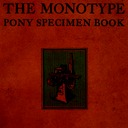
Pony Specimen Book (1921)
The Monotype Pony Specimen Book of Type Faces, Rule, Ornaments and Borders . (Philadelphia, PA: Lanston Monotype Machine Company, 1921.) This has been digitized from the New York Public Library copy by Google Books. The version linked here is a local copy of the Google Books digitization. When I cite from it in this Notebook, or reproduce extracts from it, I'll cite it as "{MTP1921}"
Specimen Book of Type Faces. (1922)
The Monotype Specimen Book of Type Faces. (Philadelphia, PA: Lanston Monotype Machine Company, 1921.) This is a pretty good digitization, and the original page scans are available as (a zip of) separate files. When I cite from it in this Notebook, or reproduce extracts from it, I'll cite it as "{MTSB1922}"
A digital version of this book, including the original page scans, is available at The Internet Archive; the link at left goes there. Here is a local copy of the PDF version and the (nicer) DjVu version.
Each entry for which a specimen exists is illustrated with a PDF version of the specimen (with both a reasonable resolution version and a full resolution version) and an image of a snippet showing at least one cutting of the face (often the face as cut for cellular differed from the face as cut for display or Giant). You can download any of these to your own computer. Please do, as this reduces network traffic.
No. 21, Binny Old Style
Adapted in 1908 from See Mackellar, Smiths and Jordan's Old Style No. 77 (ca. 1886), itself based on "a face cut in Scotland about 1863 as a modernization of Caslon." Named for Archibald Binny, co-founder of Binny & Ronaldson, predecessor of MS&J. The related italic is No. 2111, Binny Old Style Italic. {MTF1} {McGrew 36-37}
See also No. 321, Binny Old Style Modified and Binny Old Style Modified Italic, for Curtis Publishing Company. See also No. 221 ("Overgrown No. 80" and "Overgrown No. 80 Italic") for Ladies' Home Journal. {McGrew 36-37}
"... one of the best faces available for everyday 'bread and butter' use in sizes 14-point and below; in larger sizes it is most unsatisfactory." Douglas C. McMurtrie, cited in {McGrew 37}
Click here for the full-resolution version (37 Megabytes).
No. 211, DeVinne, 5 1/2 Point Body
No. 211 is not the italic of No. 21, but rather is DeVinne for 5 1/2 point body. {McGrew 364} and Alphabetical List of Type Faces [in {MTF1}]. The italic of No. 21 is No. 2111, see below
No. 2111, Binny Old Style Italic
See the related roman, No. 21, Binny Old Style {MTF1} (the specimen here is a copy of the specimen for No. 21). {MTF1}
Click here for the full-resolution version (37 Megabytes, same specimen as No. 21 {MTF1}).
No. 26, Modern Antique
The name is pure postmodern poetry. An Egyptian face adapted by Lanston Monotype in 1909 {McGrew 218-219}. No corresponding italic. {MTF1}
McGrew compares to Antique No. 3 (Linotype and Intertype).
The specimen contains the following rather nicely made typographic distinction: "['Antique' faces generally] are distinguished by their monotone weight ... there are innumerable forms of antique letters, the serifs playing an important part in classifying the various members ... this [present] form is unbracketed and is usually called Antique; if bracketed, and depending on the size of the serif curve, the face would be called Ionic, Doric or Clarendon. If the serifs were eliminated entirely the design would resemble the letters for which the popular name is 'Gothic.'"
Click here for the full-resolution version (20 Megabytes).
Note: The verso of this specimen contains No. 76, Modern Antique Condensed {MTF1} (scanned separately).
No. 31, Bruce Old Style
This has the dual distinction of being the first Sol Hess design for Lanston Monotype (1902) and, in the version redesigned by him in 1909 the first kerning italic for the Monotype. Hess adapted it from "Bruce Old Style, Series No. 20" of the George Bruce's Son & Company typefoundry (by 1869). {McGrew 52-53} {MTF1}
The Roman, Roman Small Caps, and Italic all bear the same series number (No. 31). They were supplied with alternate characters with long descenders, for which see the full PDF of the specimen.
The Specimen here calls the face "Bruce Old Style," but the various typeface and matrix information sections of the {MTF1} specimen book call it by the original Bruce foundry identification for this face, "Bruce Old Style, No. 20" (while still, of course, giving (Lanston Monotype) No. 31 as its series number).
McGrew cites this as "31EFG", using the matrix identifying suffixes to indicate Old Style Roman ('E'), Old Style Roman Small Caps ('F'), and Old Style Italic ('G').
McGrew compares to Linotype Old Style No. 3 and Italic.
Click here for the full-resolution version (38 Megabytes).
No. 311, Russian Adaptation of No. 11 Series
No. 311 is not the italic of No. 31, but rather is the Russian Adaptation of No. 11 Series, see below. {McGrew 364} and Alphabetical List of Type Faces [in {MTF1}]. The italic of No. 31 is a part of No. 31.
No. 35, Atlantic
Cut by Monotype in 1909 for The Atlantic Monthly. (Sometimes known (by Monotype? informally?) as "Atlantic Monthly", sometimes called "Modern" by Monotype.) "... recut and new sizes added in 1936." [presumably without change in series number] {McGrew 18-19} {MTF1}
The Roman, Roman Small Caps, and Italic all bear the same series number (No. 35).
McGrew compares to Lanston Monotype Scotch Roman, No. 36 (1908).
Click here for the full-resolution version (19 Megabytes).
Note: The recto of this specimen contains No. 334, Artcraft {MTF1} (scanned separately).
No. 37, English Caslon Old Style [Roman & Italic, Cellular]
By Sol Hess for Monotype "at the request of the Gilliss Press" (1903). {McGrew 66-67} {MTF1}
Although No. 37 would appear to have the normally numbered corresponding italic, No. 371, the two series differ. The specimen {MTF1} shows No. 37 cut in cellular sizes in both roman and italic and in display sizes in roman only. It shows No. 371 cut in display sizes only in italic only. No. 371 differs from the italic of No. 37 (see especially the 'B', 'F', and '&' characters for obvious examples).
McGrew compares to Linotype, Intertype Caslon No. 4.This 4-page specimen includes No. 37, English Caslon Old Style [Roman & Italic, Cellular] {MTF1}, No. 371, English Caslon Old Style Italic [Display] {MTF1}, and No. 137, Inland Caslon Old Style {MTF1}. Click here for the full-resolution version (71 Megabytes).
No. 371, English Caslon Old Style Italic [Display]
By Sol Hess for Monotype "at the request of the Gilliss Press" (1903). {McGrew 66-67} {MTF1}
Although No. 371 would appear to be the normally numbered corresponding italic of No. 37, the two series differ. The specimen {MTF1} shows No. 37 cut in cellular sizes in both roman and italic and in display sizes in roman only. It shows No. 371 cut in display sizes only in italic only. No. 371 differs from the italic of No. 37 (see especially the 'B', 'F', and '&' characters for obvious examples).
McGrew compares to Lanston Monotype No. 137 Inland Caslon Old Style.
This 4-page specimen includes No. 37, English Caslon Old Style [Roman & Italic, Cellular] {MTF1}, No. 371, English Caslon Old Style Italic [Display] {MTF1}, and No. 137, Inland Caslon Old Style {MTF1}. Click here for the full-resolution version (71 Megabytes).
No. 64, Cheltenham Old Style
Lanston copy of Goodhue/ATF Cheltenham Old Style (ATF No. 87). See Cheltenham Families in the Typeface Index.
Shown in {MTF1} for composition in 6, 8, 10, 12 point in C arrangement with combined Roman and Italic. Shown for display (Type-&-Rule Caster) in 14, 18, 24, 30 point with 91 characters. Shown for display (Type-&-Rule Caster) in 36 point with 90 characters. Shown for display (Giant Caster) in 42, 48, 60, 72 point with 77 characters. {MTF1}
This 2-page specimen includes No. 64, Cheltenham Old Style {MTF1} and No. 641, Cheltenham Old Style Italic {MTF1}.
Click here for the full-resolution version (36 Megabytes).
No. 641, Cheltenham Old Style Italic
Lanston copy of Goodhue/ATF Cheltenham Italic (ATF No. 82). See Cheltenham Families in the Typeface Index.
Shown for composition in 6, 8, 10, 12 point in C arrangement with combined Roman and Italic. Shown for display (Type-&-Rule Caster) in 14, 18, 24, 30, and 36 point with 91 characters. Not shown for Giant Caster. {MTF1}
This 2-page specimen includes No. 64, Cheltenham Old Style {MTF1} and No. 641, Cheltenham Old Style Italic {MTF1}.
Click here for the full-resolution version (36 Megabytes).
No. 76, Modern Antique Condensed
An Egyptian face adapted by Monotype in 1909 {McGrew}. {MTF1}
cf. Antique No. 3 (Linotype and Intertype) {McGrew}
Click here for the full-resolution version (20 Megabytes).
Note: The recto of this specimen contains No. 26, Modern Antique {MTF1} (20 Megabytes).
No. 78, Caslon Old Roman
"Caslon Old Roman" is not a Caslon face. It is a circa 1895 design by T. W. Smith (H. W. Caslon and Company, UK), copied in 1903 by Barnhart Brothers & Spindler, and further copied by Lanston Monotype in 1907. {McGrew} McGrew lists it as "Old Roman". {MTF1}
This is the same 2-page specimen that includes No. 781, Caslon Old Roman Italic {MTF1}, below. Click here for the full-resolution version (35 Megabytes).
No. 781, Caslon Old Roman Italic
{MTF1}
This is the same 2-page specimen that includes No. 78, Caslon Old Roman {MTF1}, above. Click here for the full-resolution version (35 Megabytes).
No. 79, Caslon Bold
By the Keystone Type Foundry (1905), then ATF No. 817. No date given for Lanston Monotype copy. N.B., the Ludlow "Caslon Bold" has a different lineage. {McGrew} The cuttings indicated in the specimen are interesting. No. 79 is listed for machine composition in 6-12pt with long descenders in 6, 8, 10 and 12pt sizes. It is also listed for machine composition in 14 and 18 pt. It is listed for hand setting in 14-36 point (display) and 42-72pt (Giant). However, No. 79 is also listed as "Caslon Bold Italic" in cellular (machine composition) sizes 6-7-8-9-10-12pt (not 14 or 18pt) with long descenders in 6-8-10-12pt. Then No. 791 is listed for hand setting in display (14-36pt) and Giant (42-72pt) sizes. {MTF1}
This particular specimen is also of great interest to the history of typesetting methods because it mentions Dr. Church's 1820 system (but without any explicit recognition that Church originated what Lanston was later to call the system of "non-distribution.")
cf. No. 537, New Caslon {MTF1} in sizes below 18 pt. cf. Linotype, A-P-L, and Intertype "Caslon No. 3" in sizes from 18 pt and up.
This is the same 2-page specimen that includes No. 791, Caslon Bold Italic {MTF1}, below. Click here for the full-resolution version (72 Megabytes).
No. 791, Caslon Bold Italic
Same info as No. 79, Caslon Bold, except that the Keystone Type Foundry date is 1906 for the italic. {McGrew} {MTF1}
This is the same 2-page specimen that includes No. 79, Caslon Bold {MTF1}, above. Click here for the full-resolution version (72 Megabytes).
No. 221, Overgrown No. 80
A variation (but derived "from another foundry source") of No. 21, Binny Old Style cut for Ladies' Home Journal in 1935. 9 point only, in 'E' (Old Style Roman), 'F' (Old Style Roman small caps), and 'G' (Old Style Italic). {McGrew}
No. 98, Bookman Old Style
An antique with a complex history dating back to modifications to an existing series by A. C. Phemister for the Miller & Richard foundry (Scotland) circa 1860. The name "Bookman Oldstyle" was first applied by ATF on its takeover of the Bruce foundry in 1901. Adapted by Lanston Monotype in 1909. {McGrew} {MTF1}
This is the same 2-page specimen that includes No. 981, Bookman Old Style Italic {MTF1}, below. Click here for the full-resolution version (70 Megabytes).
No. 981, Bookman Old Style Italic
An antique with a complex history dating back to modifications to an existing series by A. C. Phemister for the Miller & Richard foundry (Scotland) circa 1860. The name "Bookman Oldstyle" was first applied by ATF on its takeover of the Bruce foundry in 1901. Adapted by Lanston Monotype in 1909. {McGrew} {MTF1}
This is the same 2-page specimen that includes No. 98, Bookman Old Style {MTF1}, above. Click here for the full-resolution version (70 Megabytes).
No. 113, Condensed Caslon
McGrew and Monotype {MTF1} differ here. McGrew says: "Condensed Caslon is a modification of New Caslon, by Inland in 1907; ... copied by Monotype" (See Lanson Monotype No. 537, New Caslon.) He notes further that "printers often but incorrectly call it Caslon Bold Condensed." However, the specimen in {MTF1} says that "It is in reality a condensed version of [No. 79,] Caslon Bold and not a condensed form of any Caslon typeface." {MTF1}
Click here for the full-resolution version (40 Megabytes).
No. 137, Inland Caslon Old Style [Roman & Italic]
McGrew hypothesizes that this face is derived from Inland Type Foundry's No. 584 Inland Caslon Oldstyle (1901, later ATF No. 196), which was cast "on standard line" (shortened descenders and redesigned italic). {McGrew} McGrew further notes that the italic "seems identical to that of No. 37." {MTF1}
This 4-page specimen includes No. 37, English Caslon Old Style [Roman & Italic, Cellular] {MTF1}, No. 371, English Caslon Old Style Italic [Display] {MTF1}, and No. 137, Inland Caslon Old Style {MTF1}, Click here for the full-resolution version (71 Megabytes).
No. 144, Bold Antique
ATF No. 29 (MF Benton, drawn 1904, issued 1905) copied by Lanston Monotype. No corresponding italic. ATF Bold Antique reissued ca. 1963 as Whitin Black. {McGrew 44/45} {MTF1}
McGrew compares to John Hancock, but the two differ significantly in detail.
Click here for the full-resolution version (17 Megabytes).
Note: The verso of this specimen contains No. 145, Bold Antique Condensed {MTF1} (scanned separately).
No. 145, Bold Antique Condensed
ATF No. 30 (MF Benton, drawn 1906, issued 1908/9) copied by Lanston Monotype. No corresponding italic. ATF Bold Antique Condensed reissued ca. 1963 as Whitin Black Condensed. {McGrew 44/45}. {MTF1}
McGrew compares to Contact Bold Condensed.
Click here for the full-resolution version (20 Megabytes).
Note: The recto of this specimen contains No. 144, Bold Antique {MTF1} (scanned separately).
No. 175, Bodoni [1911]
This is Lanston Monotype's original Bodoni, from 1911. {McGrew} {MTF1}
No. 175 is unrelated to ATF's Bodoni (MF Benton, 1910-1911), for which see Monotype's No. 375, Bodoni [1930 Cutting]. {McGrew} Look at the 'G', 'Q', and the figures for easy-to-spot differences.
This is the same 4-page specimen as No. 1751, Bodoni Italic [1911 Cutting] and No. 775, Bodoni Bold Condensed
No. 1751, Bodoni Italic [1911 Cutting]
This is Lanston Monotype's original cutting of Bodoni, from 1911. {McGrew}
No. 1751 is unrelated to ATF's Bodoni (MF Benton, 1910-1911), for which see Monotype's No. 3751, Bodoni Italic [1930 Cutting]. {McGrew}
This is the same 4-page specimen as No. 175, Bodoni [1911 Cutting] {MTF1} and No. 775, Bodoni Bold Condensed {MTF1}
No. 194, Bodoni Bold Shaded
Monotype copy of ATF No. 26 Bodoni Bold Shaded (MF Benton, 1912, in turn adapted from ATF No. 24 Bodoni Bold Monotype No. 275 Bodoni Bold)). {McGrew} {MTF1}
This 8-page specimen includes No. 275 Bodoni Bold, No. 2751 Bodoni Bold Italic, No. 775 Bodoni Bold Condensed, No. 575 Bodoni Bold Panelled, and No. 194 Bodoni Bold Shaded.
No. 211, DeVinne for 5 1/2 Point Body
Not in {MTF1}. I'm not sure if No. 211 included an italic. McGrew cites as "211J (5 1/2 pt)" without further comment or illustration; the 'J' in his citation would suggest that there was no italic.
No. 225, Artscript
Sol Hess (1939, released 1948) for Monotype. {McGrew} {MTF1}
cf. Heritage, Lydian Cursive, Thompson Quillscript. {McGrew}
Note: The verso of this specimen is blank (and not scanned).
No. 275, Bodoni Bold
If I read McGrew correctly, this is an adaptation by Monotype of ATF No. 24, Bodoni Bold. It was cut separately from No. 775 Bodoni Bold Condensed (which was designed by Sol Hess for Lanston Monotype directly), but the showing here is identical to that specimen. {MTF1}
This 8-page specimen includes No. 275 Bodoni Bold, No. 2751 Bodoni Bold Italic, No. 775 Bodoni Bold Condensed, No. 575 Bodoni Bold Panelled, and No. 194 Bodoni Bold Shaded.
No. 2751, Bodoni Bold Italic
If I read McGrew correctly, this is an adaptation by Monotype of ATF No. 25, Bodoni Bold Italic. But note that this face differs in more than weight from No. 3751 (Bodoni Italic, based on ATF No. 23) and No. 8751 (Bodoni Book Italic, based on ATF No. 28). See the lowercase 'v' and 'w', espcially. It is actually closer in this regard to No. 1751, Bodoni Italic, Monotype's original 1911 cutting. {MTF1}
This 8-page specimen includes No. 275 Bodoni Bold, No. 2751 Bodoni Bold Italic, No. 775 Bodoni Bold Condensed, No. 575 Bodoni Bold Panelled, and No. 194 Bodoni Bold Shaded.
No. 302, Brush
Lanston Monotype copy of ATF No. 689 Brush (Robert E. Smith, 1942). {McGrew} {MTF1}
cf. Brody, Hauser Script, Kaufmann, Repro Script. {McGrew}
No. 306, Broadway
Adapted by Sol Hess for Lanston Monotype from ATF No. 506 Broadway (MF Benton, 1927/8). The ATF face has no lowercast; Hess added this for Monotype (the lowercase therefore differs significantly from the lowercase of the later ATF No. 529 Broadway Condensed, 1929). {McGrew} {MTF1}
cf. Boul Mich (BB&S, ATF) {McGrew}
No. 307, Broadway Engraved
By Sol Hess for Lanston Monotype (1928). No lowercase. {McGrew} {MTF1}
No. 321, Binny Old Style Modifed & Binny Old Style Modified Italic
A variation of No. 21, Binny Old Style cut for Curtis Publishing Company. In 5 1/2 point only? {McGrew}
I don't have a specimen for this, but McGrew lists it as "321EFG", which would indicate three variations: Old Style Roman ('E'), Old Style Roman Small Caps ('F'), and Old Style Italic ('G').
No. 322, Broad Stroke
McGrew (p. 50-51) calls this "Broad Stroke Cursive," but the specimen here simply calls it "Broad Stroke." Here it is identified simply as having been imported from Europe; McGrew further identifies it as the same face as the (English) Monotype Corporation's "Script Bold." Both faces bear the same series number, 332. McGrew is uncertain as to whether Monotype cut their own mats or simply imported English mats, and I have no further information on this. It was available in display sizes only, 14-36 pt.
The specimen reproduced here was acquired as a separate item; it is not part of {MTF1} or, to the best of my knowledge, any Lanston Monotype specimen book. It is interesting for several reasons. First, it bears no identifying information at all - the word "Monotype" never appears on it. Instead, there is simply a box where a firm might reasonably stamp its own name. The specimen indicates that the typeface was "brought from overseas especially for the use of members of the Advertising Typographers of America." I suspect, then, that this was literature produced by Lanston Monotype for the use of their customers. Second, the showing of Broad Stroke Cursive in McGrew shows three ligatures (fi, ff, fl). These are not shown in the "Characters in Complete Fonts of All Sizes" here. Third, this specimen contains a typesetting error. This face includes alternative sorts for connecting and nonconnecting versions of several characters. In the 36 point showing, they accidentally used the connecting 'p' at the end of a line, rather than the nonconnecting version.
Click here for the full-resolution version (231 Megabytes, color).
No. 334, Artcraft
By Robert Wiebking (1912) for Advance Type Foundry (Wiebking, Hardinge & Co.), first as "Craftsman," then "Art-Craft," then Artcraft. Copied (in the Roman) by Monotye in 1929. {McGrew} {MTF1}
Note: The verso of this specimen contains No. 35, Atlantic {MTF1} (scanned separately).
No. 337, Caslon Old Style
Cut by Monotype circa 1915. "... designated "MacKellar Caslon" in some early literature because it is closer to the original face associated with that foundry." "Display sizes [of Monotype No. 337] are virtually an exact copy of [ATF] No. 471." {McGrew} {MTF1}
Historical sequence (from {McGrew}): 1. Laurence Johnson has a face duplicated for him in England by the successors to William Caslon. 1858. Called "Old Style" by Johnson. 2. This was renamed "Original Old Style" by MacKellar, Smiths and Jordan upon their merge with Johnson's foundry. 3. This was renamed "Old Style No. 71" by ATF when MS&J merged into ATF at its formation in 1892. 4. This was renamed "Caslon Old Style" in 1897 by HL Bullen. 5. This was redesignated No. 471 ('4' for MS&J-sourced faces) by ATF at some later point.
No. 353, Baskerville
Copied by Lanston Monotype in 1931 from English Monotype's Baskerville, itself cut in 1923 under the direction of Stanley Morison and derived from John Baskerville's great primer size. It differs therefore from the ATF Baskerville Roman ("American Baskerville"), the provenance of which goes back through Stephenson Blake matrix strikes. {McGrew} {MTF1}
This is the same 4-page specimen as No. 3531, Baskerville Italic {MTF1}, below.
No. 3531, Baskerville Italic
This is the same 4-page specimen that includes No. 353, Baskerville {MTF1}, above. {MTF1}
No. 375, Bodoni [1930 Cutting]
This is Lanston Monotype's second cutting of Bodoni, in 1930. It is based on ATF's 1910-1911 Bodoni (No. 22, MF Benton), and is unrelated to Monotype's earlier No. 175, Bodoni [1911 Cutting]. {McGrew} Look at the 'G', 'Q', and the figures for easy-to-spot differences. {MTF1}
This is the same 4-page specimen as No. 3751, Bodoni Italic [1930 Cutting].
No. 3751, Bodoni Italic [1930 Cutting]
This is Lanston Monotype's second cutting of Bodoni, in 1930. It is based on ATF's 1910-1911 Bodoni (No. 23, MF Benton), and is unrelated to Monotype's earlier No. 1751, Bodoni Italic [1911 Cutting]. {McGrew} {MTF1}
This is the same 4-page specimen as No. 375, Bodoni [1930 Cutting].
No. 402, Bell
A 1940 Lanston Monotype copy of a 1930 English Monotype face (same name, under the direction of Stanley Morison), itself based on a face cut by Richard Austin for John Bell in 1788. {McGrew} {MTF1}
Not to be confused with Linotype's Bell Gothic (a typeface designed for setting telephone directories, the "Bell" of which comes from The Bell System). cf. Monotype No. 36, Scotch Roman. {McGrew}
No. 4021, Bell Italic
This is the same 2-page specimen that includes No. 402, Bell {MTF1}, above. {MTF1}
No. 405, Bembo
The description of this face contains not only an excellent description of it ("a 15th Century letter made adaptable to 20th Century reading requirements") but also one of the finest backhanded compliments ever to slip past a copyeditor: "Bembo is not to aesthetic to be used by the undistinguished as well as the more distinguished printer." 1929 by English Monotype and "shortly thereafter" by Lanston Monotype {McGrew} {MTF1}
No. 4051, Bembo Italic
"The italic is adapted from a 1524 face of Giovanni Taglienti" (the Roman was based on the type used by Aldus Manutius in printing Pietro Bembo's De Aetna. {McGrew} {MTF1}
No. 437, Caslon Old Style
In sizes larger than 36 point (that is, 42 & 48 point (castable on the Thompson and the Giant) and 60 & (castable on the Giant)). Copied by Lanston Monotype from Stephenson Blake's "Caslon Old Face." {McGrew} {MTF1}
No. 4371, Caslon Old Style Italic
In sizes larger than 36 point (that is, 42 & 48 point (castable on the Thompson and the Giant) and 60 & (castable on the Giant)). Copied by Lanston Monotype from Stephenson Blake's "Caslon Old Face." {McGrew} {MTF1}
No. 453, Baskerville Bold
By Sol Hess for Monotype. Designed as a companion face for No. 353, Baskerville, although that face has a different provenance. {MTF1}
No. 462, Bulmer
The Lanston Monotype version of ATF No. 497 Bulmer (MF Benton, cut 1925, released 1928), itself based on "a face cut about 1790 by William Martin for William Bulmer." {McGrew} {MTF1}
This is the same 2-page specimen that includes No. 4621, Bulmer Italic {MTF1}, below.
No. 4621, Bulmer Italic
The Lanston Monotype version of ATF No. 498 Bulmer Italic (MF Benton, cut 1926, released 1928), itself based on "a face cut about 1790 by William Martin for William Bulmer." {McGrew} {MTF1}
This is the same 2-page specimen that includes No. 462, Bulmer {MTF1}, above.
No. 537, New Caslon
A revision of Caslon by Inland Type Foundry (1905). This became ATF 331 New Caslon. McGrew isn't specific as to when Lanston Monotype copied it, but the specimen here indicates 1912. {McGrew} {MTF1}
Adapted for Linotype (and A-P-L) and Intertype as "Caslon No. 3" (colloquially "Caslon Bold"), but sizes from 18 pt up are in fact copies of Caslon Bold (Keystone / ATF No. 817, Lanston Monotype No. 79), not New Caslon {McGrew}.
No. 5371, New Caslon Italic
Same info as No. 537 New Caslon, except that the Inland Type Foundry date is 1906 for the italic. {McGrew} {MTF1}
Adapted for Linotype (and A-P-L) and Intertype as "Caslon No. 3" (colloquially "Caslon Bold"), but sizes from 18 pt up are in fact copies of Caslon Bold (Keystone / ATF No. 817, Lanston Monotype No. 79), not New Caslon {McGrew}.
No. 575, Bodoni Bold Panelled
By Sol Hess for Lanston Monotype, 1928. No points or figures. {McGrew} {MTF1}
This 8-page specimen includes No. 275 Bodoni Bold, No. 2751 Bodoni Bold Italic, No. 775 Bodoni Bold Condensed, No. 575 Bodoni Bold Panelled, and No. 194 Bodoni Bold Shaded.
No. 637, American Caslon
Designed by MF Benton in 1919 {McGrew} or "about 1920" {MTF1} as a modification of the New Caslon (Inland, ATF No. 331, Lanston Monotype No. 537) revision of Caslon-in-general. New Caslon was cut for ATF standard alignment and thus had shorter descenders; American Caslon restored longer descenders. "... otherwise this face and New Caslon are identical." {McGrew} Adapted by Lanston Monotype beginning in 1934 (smaller sizes) and later. {MTF1}
cf New Caslon comparisons: Adapted for Linotype (and A-P-L) and Intertype as "Caslon No. 3" (colloquially "Caslon Bold"), but sizes from 18 pt up are in fact copies of Caslon Bold (Keystone / ATF No. 817, Lanston Monotype No. 79), not New Caslon {McGrew}.
This is the same 2-page specimen that includes No. 6371 American Caslon Italic {MTF1}, below.
No. 6371, American Caslon Italic
{McGrew} {MTF1}
This is the same 2-page specimen that includes No. 637 American Caslon {MTF1}, above.
No. 675, Ultra Bodoni
This isn't really a Bodoni at all. McGrew likens it to 'the nineteenth-century Enlish "fat" faces." Based on ATF No. 518 Ultra Bodoni (MF Benton, 1928). {MTF1}
This is the same 2-page specimen that includes No. 6751, Ultra Bodoni Italic {MTF1}, below. {MTF1}
cf. Monotype No. 404, Onyx {MTF1}, Linotype Poster Bodoni Compressed, Intertype Palisade, Ludlow Bodoni Black, Ludlow Bodoni Campanile, and several foundry and import faces. {McGrew}
No. 6751, Ultra Bodoni Italic
Based on ATF No. 516 Ultra Bodoni (MF Benton, 1928). {MTF1}
This is the same 2-page specimen that includes No. 675, Ultra Bodoni {MTF1}, above. {MTF1}
cf. Monotype No. 4041, Onyx Italic {MTF1}, Ludlow Bodoni Black, Ludlow Bodoni Campanile, and several foundry and import faces. {McGrew}
No. 775, Bodoni Bold Condensed
By Sol Hess for Monotype, 1934. {McGrew} It was cut separately from No. 275, Bodoni Bold (which is based on ATF No. 24), but the same showing appears in the specimen for that face. {MTF1}
This is the same 4-page specimen as No. 175, Bodoni [1911 Cutting] and No. 1751, Bodoni Italic [1911 Cutting].
No. 790, Stymie Bold, 16 & 21 Point
This is an "Advance Proof" (but really just an adverting sheet) for new cuttings of Series No. 790, Stymie Bold, in 16 point and 21 point. Cut only for display. (It is not a part of {MTF1}; I obtained it as a separate sheet.)
The icon to the left links to a JPEG version of this Advance Proof, which is probably sufficient. It is 5.6 Megabytes. If for some reason you need the 21 Megabyte PNG version, click here:
No. 875, Bodoni Book
If I read McGrew correctly, this is an adaptation by Monotype of ATF No. 27, Bodoni Book. This is a lighter face than either of the "regular" Bodoni series (Nos. 175 and 375). {MTF1}
This is the same 4-page specimen as No. 8751, Bodoni Book Italic.
No. 8751, Bodoni Book Italic
If I read McGrew correctly, this is an adaptation by Monotype of ATF No. 28, Bodoni Book Italic. This is a lighter face than either of the "regular" Bodoni series (Nos. 1751 and 3751). {MTF1}
This is the same 4-page specimen as No. 875, Bodoni Book.
No. 975, Recut Bodoni Bold and Recut Bodoni Bold Italic
Cut at some point after No. 375, Bodoni Bold and No. 3751, Bodoni Bold Italic (both 1930 and based on ATF's No. 24 and 25, respectively) so as to be even closer to ATF 24 and 25. {McGrew} Both the roman and italic bear the same series number (975). {MTF1}
Lanston Typefaces by Series Number
A table of Lanston Monotype Machine Company cellular, display, and Giant faces ordered by series number. Prepared by Dr. David M. MacMillan for CircuitousRoot.
The icon here links to a static PDF of this document. Here is the source spreadsheet, in OpenOffice format: lanston-monotype-series-list-by-number.ods This spreadsheet just contains public domain data, so I've put the spreadsheet itself in the public domain. You're free to copy it, use it, modify it, or whatever. If you do modify it and distribute those modifications, it would contribute just a tiny bit to our collective sanity if you were to clearly identify your version as such.
McGrew's List of Series Numbers
McGrew, Mac. American Metal Typefaces of the Twentieth Century. (New Castle, DE: Oak Knoll Books, 1993). This book has a useful list of Monotype series numbers (and a list of ATF numbers).
Alphabetical List of Type Faces (ca. 1935-40s)
This is the list which opens my {MTF1} specimen book. It is undated, but the list of Monotype Library Faces (see below) in the same book is dated 1935-08-15. The binder of {MTF1} itself bears the address "Philadelphia 3, PA"; numeric postal zones began in 1943 and were replaced by ZIP codes in 1963.
Click here for the full-resolution version (42 Megabytes).
Machine Composition Faces (ca. 1935-1940s)
"Available Point Sizes, Set Sizes, Length of Capital and Lowercase Alphabets." "Machine Composition" means cellular matrices cut for machine composition on the Monotype Composition Caster (vs. cellular matrices cut for display composition, display matrices, or Giant Caster matrices). Undated (see the notes on the dates of {MTF1} in the Alphabetical List of Type Faces [in {MTF1}], above, but note that the "addenda" here begins with Bembo, a face that McGrew indicates was cut "shortly after" 1929, so it may in fact be earlier). {MTF1}
Click here for the full-resolution version (185 Megabytes).
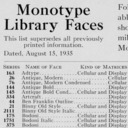
Monotype Library Faces (1935-08-15)
"... a list of type faces which may be cast from matrices available for rental in the Monotype Matrix Library." No point sizes given. These matrices include cellular matrices the bodies of which are milled for display casting (vs. cellular matrices the bodies of which are milled for composition casting) and display matrices. Interestingly, it indicates (indeed, emphasizes) that Giant Caster Matrices are not rented. This policy later changed. {MTF1}
Click here for the full-resolution version (36 Megabytes).
Design Classification of Monotype Type Faces (ca. 1935-1940s)
Modern vs. Old Style vs. Antique vs. Title vs. Gothic, etc. {MTF1}
Click here for the full-resolution version (37 Megabytes).
Matrix Information (ca. 1935-1940s)
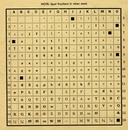
Monotype Matrix Information: For the Use and Convenience of Monotype Owners and Operators . While this document contains much useful information, it is also quite confusing for a beginner because it refers to machines by several different names. So as a matter of clarification, here are the more common variations on these names along with their equivalents as used in this document:
"Composition Caster" [not used in this document] = "Typesetting Machine".
"Composition-and-Display Caster" = "Composition Caster" + Display Type Attachment.
"Type-&-Rule Caster" = "Display Caster" = "Display Type-Caster" = "Composition Caster" + Display Type Attachment + Strip Attachment - composition abilities.
The names of the "Monotype Material Making Machine," "Junior Monotype Material Making Machine," "Monotype Giant Caster," and "Monotype-Thompson Type-Caster" are used unambiguously. {MTF1}
Click here for the full-resolution version (153 Megabytes).
Special Matrix Arrangement Information
For composition casting. Correlations of Type Face, Keybars, Wedges and Stop Bars, [matrix case] Arrangements, Point Sizes and Set Sizes, and types of Figures. {MTF1}
Click here for the full-resolution version (69 Megabytes).
(Which of course is not without educational value.)
"Opening Up" Monotype Type Faces (ca. 1935-1940s)
Subtitle: "The Monotype Unit System." {MTF1}
Click here for the full-resolution version (75 Megabytes).
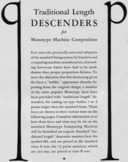
Traditional Length Descenders ("H9")
Describes alternative cuttings of several typefaces redesigned so as to have longer ("traditional length") descenders. This is promoted as a feature of Monotype machine typecasting vs. modern foundry typecasting after the introduction of the standard lining system (which resulted, they say, in "lower case letters [being] made shorter than their proper proportion dictates.") These recuttings are identified by the suffix "H9" after the point size (not the series number). Monotype Matrix Information (ca. 1935-1940s), see above identifies the meaning of the "H9" suffix as "Redesigned."
Click here for the full-resolution version (206 Megabytes).
Typically the italic variation on a series is indicated in the series number with an appended '1'. To help keep things together, I've collated the series numbers here as if the roman variations had an appended '0'. Thus No. 353 (Baskerville (roman)) is treated as if it were No. 3530, and is followed by No. 3531 (Baskerville Italic); this, in turn, comes before (say) No. 358 (Pendrawn).
Note 1: Sometimes the italic adds '11', as in No. 21 (Binny Old Style) and No. 2111 (Binny Old Style Italic.) (No. 211 is DeVinne for 5 1/2 point body.) When this happens I'll collate them as if the roman variations had an appended '00'. Thus No. 2111 (Binny Old Style Italic) goes after No. 21 (Binny Old Style), not after No. 210 (De Vinne Extra Condensed No. 2).
Note 2: Sometimes series ending in '1' are simply their own series (not the italic of another series). However, there are often numerological relationships to related series. Thus No. 321 is Binny Old Style Modified (prepending a '3' to No. 21, Binny Old Style).
Note 3: Sometimes the italic of a series bears a number apparently unrelated to its roman, although deeper relationships may lie hidden. Example: No. 790, Stymie Bold, has No. 1891, Stymie Bold Italic. History sometimes helps here. Stymie Bold (ATF) was M. F. Benton's re-drawing of Rockwell Antique (ATF), itself a reissue of Litho Antique (Inland). Lanston Monotype copied ATF's Rockwell Antique but "erroneously" {McGrew} called it Stymie Bold "in some literature." Lanston Monotype Rockwell Antique is No. 189. Lanston also issued a full series of Stymie, so named. Their Stymie Bold is No. 790. But Stymie Bold Italic is No. 1891.
Note 4: Sometimes the italic and roman both bear the same series number. E.g. Recut Bodoni Bold and Recut Bodoni Bold Italic, both of which are No. 975.
Note 5: Sometimes numbers were recycled. Thus series No. 56 is both Lining Gothic (No. 525) and Ionic. {McGrew} indicates these in his list of series numbers as one number with the two faces separated by a slash. In my spreadsheets I have separate lines for each.
This recycling gets especially interesting when it interacts with the nonstandard use of a suffixed '1'. So No. 321 was its own face (Binny Old Style Modified and Binny Old Style Modified Italic, available only in 5 1/2 point for the Curtis Publishing Company) rather than the italic of some No. 32. Then a No. 32 was introduced (in 1956), Tallone Max Factor. Its italic was numbered 321, taking over the old Binny Old Style Modified and Italic position. This isn't so difficult as history, but it complicates the making of tables (as "321" must now appear both after 32 and as a literal 321).
Note 6: Even though some series have the same number for roman and italic, it is at times useful to distinguish them (and duplicate the series number in lists, for example) because the roman and italic were cut for different machines. So for instance No. 186 Cheltenham Medium was cut in roman for cellular, display, and giant but was cut in italic only for cellular.
To take a more complex example, No. 95 is Cloister Black (cut for cellular and display). No. 95M is the German Adapatation of Cloister Black (signified by the 'M' suffix), cut for cellular only. No. 495 (no suffix) is also a German Adaptation of Cloister Black, cut for display only.
Note 7: And things get interesting when the base face is something much like an italic. Thus Inclined Gothic is No. 254 in cellular sizes (listed as No. 254K, where the 'K' suffix indicates "Boldface Italic"; the face is bold, but is not really an italic) and No. 2541 in display sizes. Some Lanston Monotype literature, though, lists it only as No. 2541.
In a stranger example, No. 89 is Clearface, the Lanston copy of the regular-weight ATF No. 91 Clearface (Benton & Benton, 1905). There are two italics for this: the expected No. 891, Clearface Italic (cut in cellular and display) and the unexpected No. 289, Clearface Italic (cut in cellular only; listed in Alphabetical List of Monotype Type Faces, but not given a specimen in {MTF1}). Handy Index of 'Monotype' Rental Matrices gives No. 2891 as "Clearface Italic (Light)", which would be a variation in weight on No. 289, not an italic version (289 is already an italic). Neither {MTF1} nor {McGrew} list No. 2891.
Note 8: Then sometimes it just seems as if the system breaks down. For example, Copperplate Gothic Bold is No. 345, which would suggest that Copperplate Gothic Bold Italic ought to be No. 3451. But instead it is No. 3461.
Sometimes the system seems just to be getting underway. For example, series No. 1 is Modern Condensed. But the italic for this is No. 411, Modern Condensed Italic (the number for which can't come from No. 4 (Cosmopolitan) suffixed by 11).
Note 9: Cellular matrices were marked not only with the series number but with a suffix indicating the classification of the face (see p. 7 of Matrix Information (ca. 1935-1940s), above, for a list). Thus matrices of the series No. 31, Bruce Old Style (which was available only in cellular sizes) would be marked "31E" (for the Old Style Roman), "31F" (for the Old Style Roman small caps), or "31G" (for the Old Style italic). Display and Giant matrices did not bear these suffixes. I have omitted them entirely here since they involve matrices rather than typeface series. (I really could dispense with this present note entirely, save that McGrew sometimes, and without explanation, uses them; thus McGrew lists Bruce Old Style as "31EFG".)
Note 10: Notwithstanding the above, the two cellular matrix suffixes 'M' (foreign faces) and 'S' (swash characters) usually (but not always) were used with both cellular and display faces in lists of faces (such as Alphabetical List of Monotype Faces {MTF1}). The presence of these suffixes does not present any confusion in the sorting order of these lists.
(However, at times very closely related series will bear very different numbers. Thus the German Adaptation of Washington Text in cellular is No. 102M, but in display is No. 4102.)
Note 11: I still don't understand the 'o' in No. 361So, Scotch Open Shaded Italic. The 'S' is the symbol for swash, and these are swash initials, but the coding of the 'o' escapes me.
(If there weren't confusing exeptions, it wouldn't be any fun at all.)
Cellular matrices employ the following letters to indicate the classification of the face. They appear after the series number, stamped on the series number side of the matrix. Sometimes these are used in references to the face in the literature, sometimes they are not.
| Monotype Matrix Information {MTF1} | {McGrew} | |
| A | Modern Roman | |
| B | Modern Roman small caps | Small Caps |
| C | Modern Italic | Italic Small Caps |
| D | Modern Italic small caps | |
| E | Old Style Roman | |
| F | Old Style Roman small caps | Old Style Small Caps |
| G | Old Style Italic | |
| H | Old Style Italic small caps | Italic Small Caps |
| J | Boldface Roman | Gothic or Bold Roman |
| K | Boldface Italic | Gothic or Bold Italic |
| L | Typewriter, Mailing List, etc. | |
| M | Foreign Faces | |
| S | Swash Characters |
Sources: Monotype Matrix Information {MTF1} . {McGrew}.
Cellular matrices employ the following letters to indicate set sizes. They appear after the point (body) size number, stamped on the point size side of the matrix.
| Z | 5-set |
| Y | 6-set |
| X | 7-set |
| W | 8-set |
| V | 9-set |
| U | 10-set |
| T | 11-set |
| S | 12-set |
| R | 13-set |
| Q | 14-set |
| O | 15-set |
| P | 16-set |
| O | 17-set |
| N | 18-set |
| M | 19-set |
Fractional sets are indicated by suffixing the following:
| a | 1/4 set |
| b | 1/2 set |
| c | 3/4 set |
Sources: Monotype Matrix Information {MTF1} .
Cellular matrices may indicate their unit values using the following lowercase letters. If present, these appear after the series number, stamped on the series number side of the matrix. Note, however, that:
"Alphabetic characters do not have any unit value symbol because their width is fixed by standard arrangement and set-size." Monotype Matrix Information {MTF1}, p. 7 .
"When point-size and set-size are the same, matrices do not have any unit value symbol." Monotype Matrix Information {MTF1}, p. 7 .
Sources: Monotype Matrix Information {MTF1} .
Cellular matrices for fractions employ these symbols. They appear after the point (body) size number, stamped on the point size side of the matrix. (Normally this is where the set size is indicated. Note that these symbols and the set-size symbols (see above) do not overlap.)
| J | Modern figure fractions |
| K | Old Style figure fractions |
Sources: Monotype Matrix Information {MTF1} .
I've got a bit more work to do to understand the encoding of fraction matrices.
Cellular matrices may employ various (alphanumeric) symbols to indicate miscellaneous characteristics.
The following symbols appear after the point (body) size number, stamped on the point size side of the matrix. (Normally this is where the set size is indicated. Note that these symbols and the set-size symbols (see above) do not overlap.)
These are symbols for cellular matrices. Some of them, however, seem to be used when designating display matrix series (e.g. 'H4'); I don't know my Monotype semiotics well enough, yet, to explain this.
Sources: Monotype Matrix Information {MTF1} .
The following symbols appear after the series number, stamped on the series number side of the matrix.
| N | border |
| P | sign |
| Q | logotype (not the ligatures fi, fl, ff, ffi, ffl, which are parts of fonts). |
| R | dash or leader |
| S | bracket, parenthesis, brace, or piece brace |
| T | cross rule |
| X | unclassified character |
| Y | brace |
Sources: Monotype Matrix Information {MTF1} .
Monotype Matrix Information {MTF1}, p. 7 . indicates that "no letters are used in marking display matrices." I have, however, seen letters on matrices; I don't yet know enough to interpret them.
The standard numbers stamped on a display matrix have the following meanings:
| upper left | point (body) size |
| upper right | series number |
| lower left | (special) Normal Wedge 47S |
| lower right | Justification Wedge 46S |
If the lower left number is starred, this indicates that the Abutment-Screw Packing Piece (60S) must also be in place.
Source: The Monotype System, (Philadelphia: Lanston Monotype Machine Company, 1916). pp. 164, 159.
"[English] Display matrices are marked with the face series number and point size of hte type to be cast from them; also with the set measurement in points. Thus, 199-18 towards one end of the matrix means that the face series is No. 199 and the body size is 18 point. At the other end of the same edge of the matrix is a number indicating the 'set' size in points to which type must be cast from the matrix, such as 16 3/4, indicating the sizing wedges must be adjusted to 16 3/4 points."
Source: The 'Monotype' Casting Machine Manual, (London: The National Committee of Monotype Users' Associations In Association with The Monotype Corporation Limited, 1952). pp. 191-192.
"Figures at bottom of Matrix indicate point size and series number; at top, width of body in points on which type should be cast."
Sources: Monotype Matrix Information {MTF1} .
The arrangement of type specimens in the next section is by Series number. This will no doubt drive you bonkers if you're a printer and think in terms of typeface names. Remember, I'm not a printer, I'm a typefounder - and typefounders organize their matrix vaults by the numbers. Here, then, is an index by typeface names into the specimens to follow.
Note (For those unfamiliar with metal type): All faces are ordinary Roman (vs. Italic, Condensed, Expanded, etc.) unless specified otherwise. Frequently the variations were designed and cut later, and/or were adapted from other sources.
Yet another note: This table lists as many permutations of each face name as I'd guess one might encounter. For the real name of the face, see the Specimen(s).
The list of Lanston Monotype typefaces by series number prepared by David M. MacMillan is in the public domain.
The Monotype Type Faces specimen book identified here as "MTF1", and each element of its contents individually, was (were) published in the US without copyright notice at a time when such notice was required to secure copyright. It (they) therefore passed into the public domain upon initial publication. Their digital reprints here remain in the public domain.
The Lanston Monotype publication(s) "Broad-Stroke" was (were) published in the US without copyright notice at a time when such notice was required to secure copyright. It (they) therefore passed into the public domain upon initial publication. Their digital reprints here remain in the public domain.
All portions of this document not noted otherwise are Copyright © 2010 by David M. MacMillan and Rollande Krandall.
Circuitous Root is a Registered Trademark of David M. MacMillan and Rollande Krandall.
This work is licensed under the Creative Commons "Attribution - ShareAlike" license. See http://creativecommons.org/licenses/by-sa/3.0/ for its terms.
Presented originally by Circuitous Root®
Select Resolution: 0 [other resolutions temporarily disabled due to lack of disk space]