Topic Index
This site is in fact logically organized - yes, really. It just isn't necessarily the logic you might expect. If you're here to find something specific (especially reprinted texts), you would do best to consult this Topic Index first.
If you do simply dive in without checking the Topic Index, please note that almost everything is in the "Mechanics: Type Machinery In Detail" section; the other sections are perhaps well intentioned but at the moment quite sketchy.
Preliminaries
[Offline for now - it was getting too out-of-date. The link at left will fail.] Old news and out-of-date updates. Organization of this site.
History of Printing
I am not a printer and this website really isn't about printing (it's about making printing type). But the printing and typemaking are obviously linked and a good bit of the history of (and the history of our understanding of) type was established by printers. Do not expect anything comprehensive here! These are just a few notes on selected topics.
Surveys: Type Processes and Machinery
[NOTE: These survey Notebooks are very incomplete. Unless you're looking for something specific in them, you almost certainly want to go instead to the various "Mechanics: Type Machinery in Detail" Notebooks below.]
Historical, conceptual, and other general surveys of relief typemaking and printing techologies. Reprints of general literature of the field, including The Inland Printer . Typographic Examples and Instruction.
A List of Current Typefoundries.
Also: CircuitousRoot's equipment: a quick look, the state of the Typefoundry and Press, and type & matrix inventories. Rigging Tales.
A Heretic's Guide to Type
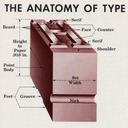
Nearly all of what is being taught about the theory and terminology of "type" in the digital world is wrong, and simply perpetuates errors made by ignorant computer programmers in the late 20th century. If you try to use these concepts to understand metal type you will fail because they do not describe type.
Much of the history of type as it is now commonly repeated is a fiction created by type foundries and composing machine manufacturers in order to sell more of their products.
Also, a guide to Reading Metal Type Specimens.
Hand Casting
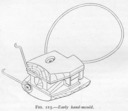
The Typefounder's hand mold and its use.
(This section will also include material on those few auxiliary tools which were unique to hand casting (e.g., the ladle). But most of the tools of the hand caster also found a place in machine casting (e.g., alignment gauges). For these, see Noncomposing Typecasters, below.)
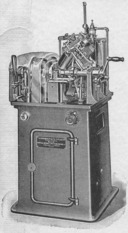
Noncomposing Typecasters
Machines which cast individual types to be used in hand composition. The Thompson Type-Caster, and Nuernberger-Rettig (aka Universal) Typecaster, the Monotype Type-&-Rule Caster. Church's 1822 system. Type Foundry Specimens & Typography.
The Thompson (suitably equippped with now rare accessories) and (more commonly) the Monotype display machines could produce not only individual types but also strip material through fusion casting. For machines devoted exclusively to strip material, whether continuous-cast or fusion-cast, see the Strip-Casters Notebooks, below.
Also, a List of All Type Specimen and Matrix Information on CircuitousRoot .
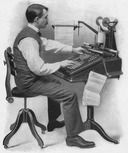
Composing Typecasters
The Monotype Composition Caster. General Monotype literature.
[IN PROCESS: Monotype Matrix Data, Specimens, & Typography.]
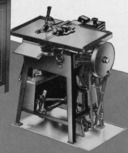
Noncomposing Linecasters
The Ludlow Typograph. Reprints of Ludlow Literature. Ludlow Matrix Data, Specimens, & Typography.
[Nothing yet on the A-P-L or Nebitype]
As is the case with the Composing Linecaster Notebooks, above, these Notebooks concern details of the machinery, not its daily use or the acquisition of our own machines.
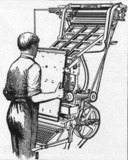
Composing Linecasters
Linotype and Intertype: Principles, Practice, Maintenance & Restoration, Auxiliary Machines, and Reprints of Literature.
[NOT DONE: Linotype/Intertype Matrix Data, Specimens, & Typography.]
This set of Notebooks is indended to address fairly detailed technical issues in the construction, maintenance, and restoration of these machines. For the adventure of hauling home this equipment, see the accounts in Introduction II - Surveys of the Equipment . For their ordinary use (and daily maintenance) see " Composing and Casting Type," below.
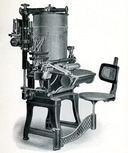
Noncasting Type Composing Machinery
The Paige. The Thorne/Simplex/Unitype. (Brief notes on a few other machines.) Logotype schemes and machines. Attempts at a taxonomy of these diverse machines.
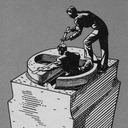
Making Printing Matrices & Types
Everything I can put together concerning the making of physical printing matrices and types except casting machines (for which see Noncomposing Typecasters, above). Punchcutting (hand and machine), patrix cutting (hand and machine), matrix electroforming, matrix cutting, typemetal, type finishing and fonting, etc. Bibliography of type-making and reprinted literature. Also some history of type design, but with an emphasis on punchcutters and typefounders. This is a huge topic, and what I have here is very incomplete.
Strip-Casters
Machines devoted exclusively to casting strip material.
True continuous-casting strip-casters. The Elrod. The Universal.
Fusion-casting machine. [NOTHING YET] The Monotype Material Maker.
For fusion-casting machine capable of producing both types and strip material, see the Thompson and various Monotype display casters in " Noncomposing Typecasters," above.
Common Casting Equipment
("Common" in the sense of "used with multiple kinds of casting machines.") Metal Feeders. [Remelting Furnaces and Molds (except Hammond and Monomelt).] [Thermometers.] [Typemetal Assaying.]
Note also that letterpress methods (both hand-set and hot metal type) have often been used for processes other than conventional letterpress printing. These are covered elsewhere, and include:
Stereotyping
Just some literature right now: "Electricaster." Hammond MatMakir, EasyKaster, RouterPlaner.

Electrotyping of Printing Plates
The use of electrolytic deposition to produce printing plates. At present all that is here is some literature on the very early development of electrotyping.
Not Patrix Cutting and Matrix Electroforming or Literature on Electroforming Matrices, even though these process were also most typically called "electrotyping" in the 19th and 20th centuries.
Nontypographical Cuts and Ornaments
In each of the three sections above ( Stereotyping, Electrotyping, and Photoengraving) there should be a subsection of specimen literature for cuts and decorative material offered from stock (as opposed to that made to special order for a customer). However, it isn't always obvious from the surviving specimens what process was used - so I've put them all in a single section here.
This section excludes ornaments cast as type or borders, cuts and ornaments sold by typefoundries (regardless of process), and ornamental material sold in linecasting or typecasting matrix, border slide, or rule mold form.
Letterpress for Nonrelief Processes
Letterpress methods adapted for non-relief printing processes: The Ludlow Brightype System for photographing letterpress composition for offset plates. The Ludlow/Hammond Hot Metal Paste-Up system.
This is the opposite of photoengraving (see above) and photopolymer plate technology / flexography, which are the use of nonletterpress techniques (photographic and digital composition) to produce relief printing plates.
Composing Room Equipment
Printer's Saw: Literature (Hill-Curtis/Hammond TrimOsaw, C&G/Morrison, Nelson). Honig (Universal Mono-Tabular) Rule Broach.
[NOT DONE] [Wiring the Hammond Glider G Trim-O-Saw.] [Making a Full Rouse Slug Cutter Out of Two Partial Ones.] [Derusting Galleys.] [Recasting a Morrison/C&G Wheel Guard]
Printing Presses
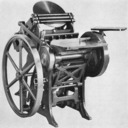
Sigwalt and Kelsey literature. Golding Pearl trucks. Miller literature. Pointers to C&P literature. C&P Cylinder literature.
Bindery
Paper handling (cutting, folding) and bookbinding equipment normally found in an older printing establishment. (For similar equipment intended for an office environment, see An Office Miscellany up and over in the Typefounding, Lettering, & Printing set of Notebooks.)
Use: Type Machinery Operation
Offline for now (and often unfinished); the link at left will fail.
[Setting Type by Hand and Printing from It.] Casting Machine Operation: [Linotype/Intertype], [Ludlow], [Elrod], [Thompson], [Monotype Type-&-Rule]. [Presswork.] [Binding and Finishing]
Pi
Offline for now (and often unfinished); the link at left will fail.
The Linotype as Steampunk. Typographical Ornaments in the 1981 edition of Crowley's Little, Big
The Circuitous Root Typefoundry and Press is a strange sort of undertaking, I suppose. It is my hobby/nonprofit project to restore, research, understand, use, and (most importantly) to document a small collection of old typecasting and letterpress equipment and technical literature.
I think of it primarily as a typefoundry, because my interest is in all the ways of making and using relief printing type - but mostly making. I run both linecasting machines (Linotype and Ludlow) and typecasting machines (Thompson). In the future I hope to add stripcasting (Elrod), a Lanston Monotype display caster, and the making of matrices by various processes. CircuitousRoot is a private typefoundry and press, in the tradition of the "private press" movement. By this I mean only that I will cast and print whatever I wish, for myself and for my friends, rather than take on commercial business.
Even so, the primary product of the foundry and press will not be the type I cast or the sheets I print, but rather the collection of "Notebooks" which I am writing and presenting here to document my experiences with and research into this equipment. It is a great irony that while this technology produced virtually all of the world's print for well over a century, much of the detailed technical knowledge of its operation was itself never committed to print and has remained an oral tradition of a now vanishing tribe. I'm just trying to learn and preserve this knowledge before it is lost forever.
A 2008 search of the USPTO records indicated that while "LINOTYPE" remains a trademark in category 9 for software and typefaces, the original trademark in category 7 for a "machine for producing type bars" / "typesetting machine" (registered 1909-06-29) had expired in both its original and later registrations.
A 2008 search of the USPTO records indicated that the trademark "INTERTYPE", originally registered 1913-06-03, was expired.
A 2008 search of the USPTO records indicated that the trademark "LUDLOW" in category 7 for printing machinery, registered 1949-11-01, was expired. A search for "ELROD" discovered no trademark registration at all.
A 2008 search of the USPTO records indicated that while "MONOTYPE" remains a trademark in category 9 for typefaces and their digital storage, the original trademarks in category 7 for a "type casting and composing machines" and in category 16 for "paper ribbons or controllers" for the same (both registered 1906-02-27) had expired
The FSA/OWI photograph of a card catalog is a US federal government work that is in the public domain by law.
The ITU Lessons in Printing [Unit II] Display Composition, from which the linking illustration for "Preliminaries" is taken, was copyright 1957. This copyright was not renewed, as would then have been required. It therefore passed into the public domain upon the expiration of its original copyright in 1985.
The Mergenthaler Linotype Company Linotype Leadership, from which the linking illustration for "Surveys: Type Processes and Machinery" is taken, was copyright 1930. This copyright was not renewed, as would then have been required. It therefore passed into the public domain upon the expiration of its original copyright in 1958.
The Intertype Corporation Streamlined Intertype Line Composing Machines, from which the linking illustration for "Mechanics: Type Machinery in Detail" is taken, published without copyright notice at a time when such notice was required to secure copyright. It therefore passed into the public domain upon its initial publication.
The Ludlow Company Ludlow Model M, from which the linking illustration for "Use: Type Machinery Operation" is taken, published without copyright notice at a time when such notice was required to secure copyright. It therefore passed into the public domain upon its initial publication.
The photograph of pied mats is one that I took of mats that, indeed, I pied. As I'm using it as a linking image here, I'll put it in the public domain.
All portions of this document not noted otherwise are Copyright © 2008-2017, 2022 by David M. MacMillan.
Circuitous Root is a Registered Trademark of David M. MacMillan.
This work is licensed under the Creative Commons "Attribution - ShareAlike" license, version 4.0 International. See http://creativecommons.org/licenses/by-sa/4.0/ for its terms.
Presented originally by Circuitous Root®